
I help founders understand their options clearly before they commit to any structure, provider, or direction.
Quick Summary: Dubai Mainland License Cost in 2026
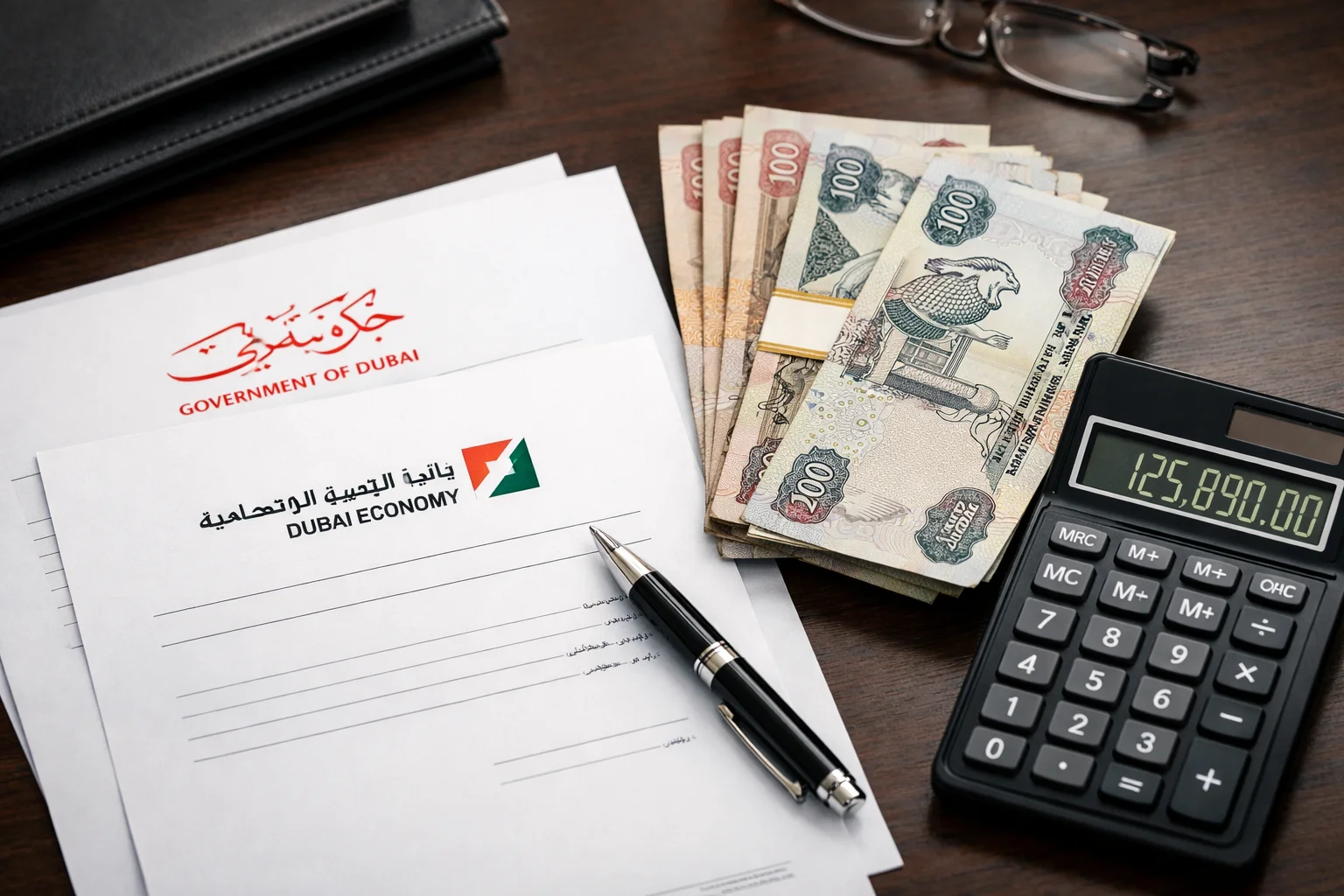
- Total first-year budget: your Dubai mainland company formation cost is built from the DET license fee (generated for your activity and legal form – DET publishes no flat price), the office lease, Dubai Chambers membership and per-visa fees; it rises with activity, office, visas and external approvals.
- Core DET government fees: the license fee generated for your activity and legal form, plus initial approval, trade name reservation and Dubai Chambers membership (AED 300–2,200 a year depending on legal form and activity).
- Office requirement: A Normal mainland license needs an Ejari-registered office; DET's Instant License, for activities that need no external approval, includes a virtual site for the first year. Costs vary by location — Business Bay flexi-desk options start lower than premium Sheikh Zayed Road space.
- Visa costs: each investor, partner or employee visa carries GDRFA/ICP entry-permit and residence fees, a medical fitness test and Emirates ID issuance, charged under the authorities' fee schedules.
- Annual renewal: DET generates the renewal fee per license; add Ejari renewal (AED 220 at a trustee centre) and Dubai Chambers membership from year 2. Renewal can cost less than the first-year license fee.
- Hidden costs to plan for: Document attestation, NOC fees, external approvals for regulated activities (food, healthcare, construction) and corporate bank account minimums.
The Total Cost of a Mainland License Extends Beyond DET Fees
When entrepreneurs ask about Dubai mainland license costs, the Dubai Department of Economy and Tourism (DET, formerly the Department of Economic Development or DED) license fee is often the first figure that comes to mind. However, this represents just one component of a broader financial commitment. The total investment required to legally establish and operate a mainland company typically includes government charges, office leasing, visa sponsorship, and several ancillary expenses that can be easily overlooked during initial planning.
This guide offers a transparent, component-by-component breakdown of the expenses founders can anticipate in 2026, drawing on Dubai’s fee legislation and the Dubai Chambers, Dubai Land Department and GDRFA fee schedules, checked in October and November 2026. Dubai's April 2026 relief package deferred some business fees for three months rather than cutting them. A second, larger package announced on 21 May 2026 went further for named sectors, with exemptions from certain DET and Dubai Municipality fees, including market fees and foreign trade name fees. If your activity is in one of those sectors, check whether an exemption applies; the figures below are the standard rates. The objective is to provide a realistic budget framework that accounts for both one-time and recurring costs, enabling better financial planning and informed decision-making. For the full setup picture beyond cost – choosing between mainland and free zone, the step-by-step process and timelines – see our complete guide to business setup in Dubai.
Estimate your figure first: our free business setup cost calculator builds a line-by-line mainland estimate for your activity, office and visa count, and our mainland vs free zone guide shows which route is cheaper for your case.
Core DET Government Fees Breakdown

The DET fees represent the administrative foundation of your company setup. For a new mainland company (LLC) in 2026, the following ranges are typical:
| Fee Component | Typical Range (AED) | Notes |
|---|---|---|
| Trade Name Reservation & Registration | 200 to reserve a name; 2,000 for a foreign or numeric name | Statutory figure from Executive Council Resolution No. 13 of 2011; the DET payment voucher adds knowledge, innovation and service charges, so the amount paid is higher |
| Initial Approval Fee | 100 | Statutory figure from the same resolution, with the same caveat |
| License Issuance Fee | Generated per activity and legal form | DET publishes no flat license price; the fee is produced for your specific activity, legal form and number of partners. The 2011 resolution names three activity fees: general trading and investment at 15,000 to issue and 3,000 to renew, and contracting at 10,000 to issue and 3,000 to renew |
| Commercial Registration Fee | 200 | A separate service line for registration in the commercial register (same resolution, same caveat) |
| Market Fees | Variable | A fee linked to your business premises and administered with Dubai Municipality. It appears in the fee breakdown generated for your license and is often the largest variable line for a company with leased premises |
| Dubai Chambers Membership | 300 – 2,200 annually | Membership follows the DET license for most companies; Dubai Chambers’ rules exempt the micro and small enterprises and simple trades that it designates with DET. Most members pay 300 to 2,200; the schedule starts at 50 for simple handicrafts, and members of the Mohammed Bin Rashid Establishment for SMEs are exempt for five years |
| Appointing a service agent | 700 | Only where a Local Service Agent is required. Statutory figure from the same resolution |
| Memorandum of Association | Quoted at notarisation | Needed for an LLC; ask for it as its own line in any breakdown |
These are base government fees. If your activity requires a Local Service Agent (LSA), which applies where non-UAE nationals hold a professional license as a sole establishment or civil company, add the agent’s annual fee. That fee is a private payment agreed with the agent, not a DET charge. A single-owner LLC does not need a Local Service Agent.
Lower-cost official routes: Instant License and eTrader
Two DET options change the budget for the right business. The Instant License is issued within five minutes for activities that need no external approval and comes with a virtual site for the first year, Dubai Chambers membership and both establishment cards – GDRFA, and MOHRE with the option to employ three people. It is available for LLCs, single-owner LLCs, sole establishments and civil companies.
The eTrader License is a sole-establishment license for Dubai home-based businesses. Check its eligibility conditions on Invest in Dubai before you apply: Dubai’s licensing law allows home-based licenses for UAE nationals (Law No. 13 of 2011, Article 18), so nationality and activity conditions can apply. Invest in Dubai lists it at AED 1,070 (license, knowledge and innovation fees) plus AED 300 for Dubai Chambers membership, applied for through the Invest in Dubai portal.
A Dubai free zone company trading on the mainland
There is also a route that avoids a new mainland company. Under Executive Council Resolution No. 11 of 2025, a company licensed in a Dubai free zone can operate in mainland Dubai with a DET branch license, at AED 10,000 a year, or a temporary permit for specific activities, at AED 5,000 for up to six months. Financial firms licensed in the DIFC are excluded. If you already hold a Dubai free zone license, price this route before you set up a separate mainland company.
Office Requirement Costs: A Major Budget Variable

A physical office space in Dubai is generally required for mainland license holders. The cost of fulfilling this requirement often represents the largest variable in your setup budget.
Ejari Registration
The official tenancy contract registration with the Real Estate Regulatory Agency (RERA), known as Ejari, costs AED 220 at a Real Estate Services Trustee centre, the route most companies use. The AED 177.75 app price applies where tenant and landlord are both individuals.
Workspace Options
To manage upfront costs, many startups begin with a flexi-desk or shared office arrangement, which is quoted by the business centre. A private office suitable for a small team is quoted by the landlord per unit and location.
Impact on Visa Quota
Office size directly influences the number of visas you can sponsor, but it is one of four things the ministry weighs. MOHRE sets the quota from the company’s legal status, the size of its work facilities, the projects it has taken on and its business requirements, with evidence from the employer (Cabinet Resolution No. 203 of 2022). A bigger office alone does not guarantee more visas, so plan the team and the lease together.
Visa and Immigration-Related Costs

Sponsoring residency visas for investors, partners, and employees represents a separate and significant cost category distinct from the business license itself.
- Establishment Card (Company Immigration File): GDRFA charges AED 200 plus 5% VAT to issue it, plus AED 10 Knowledge Dirham, AED 10 Innovation Dirham and an AED 50 service fee; the card is renewed with the company
- Investor/Partner Visa: Includes application processing, medical screening, Emirates ID, and visa stamping. Charged per person under the GDRFA/ICP, medical-centre and Emirates ID fee schedules
- Employee Visa: Similar cost structure per employee, plus the MOHRE work permit, which costs AED 250 to AED 3,450 to issue or renew depending on the company's MOHRE classification (A, B or C)
- Medical Insurance: Required for all visa holders. Premiums are quoted by the insurer per person and rise for more comprehensive plans
External Approval and Activity-Based Costs
If your business activity falls under regulatory oversight, additional approvals from relevant government bodies may be required. These costs vary considerably depending on your specific business activities.
- Dubai Municipality: May be required for activities including food trading, construction, or logistics. Fees follow the municipality's own schedule
- Dubai Health Authority (DHA): Licenses health facilities and health professionals in Dubai. Medicine import and registration are handled federally by the Ministry of Health and Prevention. Fee structures vary significantly based on the specific activity
- Other Regulatory Bodies: Approvals from SIRA (security), KHDA (education), RTA (transport), or Civil Defence may be needed, each with distinct fee structures
Confirming these requirements during the initial activity selection stage can help prevent budget surprises later in the setup process.
One-Time Versus Recurring Costs
Have questions about this?
A 10-minute call with Mirza often saves weeks of research. No obligation — ask anything about your situation.
Initial Setup Costs
- Trade name registration
- Initial approval fee
- License issuance fee (first year)
- Establishment card opening
- Document translation and attestation
- Professional service fees (if engaging a consultant)
- Office security deposit (typically 1-2 months' rent)
Annual Recurring Costs
- License renewal fee (often lower than the first-year fee)
- Office rent
- Ejari renewal
- Dubai Chamber membership
- Employee visa renewals and insurance
- Local Service Agent fee (if applicable)
- Establishment card renewal
- Annual external permit renewals
Hidden or Commonly Overlooked Costs
Several expense categories can be easily underestimated during initial budget planning:
- Professional Service Fees: Business setup consultants typically charge from a few thousand to tens of thousands of AED for end-to-end assistance. While this represents an additional cost, professional guidance can streamline the process and help prevent compliance errors
- Document Attestation and Translation: Required for foreign documents. Translation services are quoted per document
- Lease Deposits and Agency Fees: Usually 1-2 months' rent as a security deposit, plus any broker commission quoted on the lease
- Office Fit-Out and Utilities: Basic furniture, internet connectivity, and utility connections (DEWA)
- Corporate Bank Account: Some banks may require a minimum deposit, set by the bank, to open a business account
- Accounting and Audit Fees: Annual financial auditing requirements for LLCs, along with potential corporate tax registration obligations
Annual Renewal Cost Considerations
A Dubai license normally runs for one year and must be renewed in the last month before it expires. On request, and with DET’s approval, the term can be longer, up to four years (Law No. 13 of 2011, Article 8). The renewal cost is not a flat fee but rather involves recalculating several core components:
- DET License Renewal Fee: Generated by DET per license. It is not always in line with the first-year fee: in the 2011 fee resolution, general trading, investment and contracting licenses renew at AED 3,000 against AED 10,000 to AED 15,000 to issue
- Office Rent: Subject to potential annual increases
- Visa Renewals: Medical examination, Emirates ID renewal, and insurance costs for each sponsored individual
- Chamber of Commerce Fee: Annual membership payment
Incorporating renewal costs into ongoing operational budgeting helps maintain financial sustainability beyond the initial setup phase.
Two Example Budgets, Line by Line
These two examples list the cost lines for common setups and who sets each price. They do not give totals, because the main lines are generated or quoted for each case.
Scenario 1: Single-Owner Professional Service Company (Consultancy)
- DET License and Government Fees: generated by DET for the professional activity and legal form (trade name, approval, license)
- Local Service Agent Fee: agreed privately with the agent (annual), if you set up as a sole establishment or civil company; a single-owner LLC does not need one
- Flexi-Office (Shared): quoted by the business centre
- Owner Visa and Insurance: per the GDRFA, medical and Emirates ID fee schedules plus the insurer's premium
- Professional Service Fee: quoted by the consultant
- Estimated First-Year Total: the sum of the above
Scenario 2: Trading Company (LLC) with 2 Visas
- DET License and Government Fees: generated by DET for the commercial activity and legal form
- Private Office (Small): quoted by the landlord
- 2 Investor Visas and Insurance: per the GDRFA, medical and Emirates ID fee schedules plus the insurer's premium
- External Approvals (if applicable): per the regulator's fee schedule
- Professional Service Fee: quoted by the consultant
- Estimated First-Year Total: the sum of the above
Strategic Cost Planning for Mainland Setup
Understanding the comprehensive breakdown of Dubai mainland license costs represents an essential first step in successful business establishment. The initial DET license fee is merely the starting point. Your total investment will be influenced by your choice of business activity, office solution, team size requirements, and any specialized regulatory approvals.
Founders may find it helpful to:
- Define your business activity with precision, as it determines license type and external approval requirements
- Model different office scenarios to balance visa requirements with available budget
- Account for both initial outlay and recurring annual costs to ensure cash flow sustainability
- Consider professional guidance, as experienced consultants can navigate regulatory complexities efficiently and potentially help avoid costly compliance oversights
Approaching mainland company setup with this detailed financial perspective enables more informed capital allocation and establishes a solid operational foundation in Dubai's business environment.
Sources & Official References
The information in this guide reflects current UAE federal and emirate-level regulations. For the most up-to-date figures and procedures, consult the official sources below:
- Dubai Department of Economy and Tourism (DET) — Official DET fee schedules and licensing services.
- Invest in Dubai – Request to issue a trade license – Normal, Instant and eTrader licenses and the eTrader fee.
- GDRFA Dubai – Establishment card – issuance fee and additional charges.
- UAE Government Portal – Work permits – MOHRE work permit fees by company classification.
- Dubai Media Office – April 2026 economic measures – three-month fee deferrals from 1 April 2026.
- Invest in Dubai — Business set-up — DET’s official business set-up portal.
- UAE Government — Starting a business on the mainland — Federal portal on mainland licensing steps.
- Dubai Chambers — Membership fee schedule (AED 300–2,200 by legal form and activity).
- Dubai Law No. 13 of 2011 – license term, renewal window, Local Service Agents and home-based licenses (Articles 8, 15, 16, 18).
- Executive Council Resolution No. 13 of 2011 – DET’s statutory fees and fines.
- Executive Council Resolution No. 11 of 2025 – free zone companies operating in mainland Dubai (AED 10,000 branch license, AED 5,000 permit).
- Dubai Chambers Board Resolution No. 4 of 2023 – who must be a member and who is exempt.
- UAE Government Portal – recruiting on the mainland – the four criteria MOHRE uses to set a visa quota.
- Dubai Media Office – May 2026 economic package – sector exemptions from certain DET and Dubai Municipality fees.
- Ministry of Finance – Small Business Relief extended to 2029 – relief for businesses with revenue up to AED 3 million.
- Dubai Land Department — Ejari registration fees.
Frequently Asked Questions About Dubai Mainland License Costs
What is the total cost to set up a mainland company in Dubai in 2026?
The total first-year cost is built from the DET license fee (generated for your activity and legal form – DET publishes no flat price), office space, visa sponsorship, and ancillary costs, so it depends on business activity, office solution, and visa requirements rather than on a published range.
How much does company formation cost on the Dubai mainland?
There is no flat price. The Dubai mainland company formation cost is the DET license fee generated for your specific activity and legal form, plus trade name reservation, initial approval and Dubai Chambers membership (AED 300–2,200 a year), then an Ejari-registered office lease and per-visa immigration fees. A single-visa service company sits well below a trading LLC with staff visas and a larger office, so budget from your own activity and visa count rather than a headline figure, and use the business setup cost calculator for a line-by-line estimate. A licensed partner files the application.
How much does a DET business license cost in Dubai?
DET does not publish a flat license price; the issuance fee is generated for your specific activity, legal form and number of partners. Additional government fees include trade name registration, initial approval, and Dubai Chambers membership (AED 300-2,200 annually depending on legal form and activity).
What is the cheapest way to get a Dubai mainland license?
For a home-based sole proprietor who meets its eligibility conditions, the eTrader License: Invest in Dubai lists it at AED 1,070 (license, knowledge and innovation fees) plus AED 300 for Dubai Chambers membership. For activities that need no external approval, the Instant License avoids a first-year office lease because it includes a virtual site for the first year. From year two you need Ejari-registered premises.
What are the office space requirements for a Dubai mainland license?
A physical office address in Dubai is generally required for mainland license holders. Options include flexi-desk arrangements quoted by the business centre or private offices quoted by the landlord. Office size is one of four factors MOHRE weighs when it sets the visa quota, alongside legal status, projects and business requirements. The tenancy contract must be registered through Ejari with RERA.
How much does it cost to sponsor employee visas in Dubai?
Investor, partner and employee visas are charged per person under the GDRFA/ICP, medical-centre and Emirates ID fee schedules, with the MOHRE work permit added for employees. Mandatory medical insurance is quoted by the insurer per person. An establishment card (company immigration file) costs AED 200 plus 5% VAT and AED 70 in knowledge, innovation and service fees at GDRFA, and is renewed with the company.
What is a Local Service Agent (LSA) and how much does it cost?
A Local Service Agent is required where non-UAE nationals hold a professional license as a sole establishment or civil company. The agent is not a sponsor or a partner: under Dubai Law No. 13 of 2011 the agent holds no share and bears no civil or financial liability for the business, and the relationship is set out in a notarised agency agreement on DET's template. The agent's annual fee is agreed privately and is separate from DET's fees. A single-owner LLC does not need one.
What are the hidden costs of setting up a mainland company in Dubai?
Commonly overlooked costs include document attestation and translation (quoted per document), office lease deposits (1-2 months' rent), any broker commission, office fit-out and utilities, professional service fees, and corporate bank account minimum deposits set by the bank. Annual accounting and audit fees for LLCs should also be factored into budgets. Mainland companies are also subject to UAE corporate tax at 9% on taxable income above AED 375,000. A business with revenue of AED 3 million or less can elect Small Business Relief and be treated as having no taxable income; the Ministry of Finance has extended the relief to tax periods ending on or before 31 December 2029.
How much does it cost to renew a Dubai mainland license annually?
Annual renewal involves several recurring costs: the DET license renewal fee (generated per license, and often lower than the first-year fee), office rent (subject to potential increases), Ejari renewal (AED 220 at a trustee centre), visa renewals for all sponsored individuals (including medical, Emirates ID, and insurance), Dubai Chambers membership (AED 300-2,200), and Local Service Agent fees if applicable.
Do I need external approvals for my Dubai mainland business, and what do they cost?
External approvals depend on your business activity. Dubai Municipality approval may be required for food trading, construction, or logistics, charged under the municipality's own schedule. Dubai Health Authority (DHA) approval is essential for healthcare businesses; medicine import and registration are handled by the federal Ministry of Health and Prevention. Other activities may require approvals from SIRA (security), KHDA (education), RTA (transport), or Civil Defence, each with distinct fee structures. Confirming requirements during activity selection helps prevent budget surprises.
Have a question about this?
Leave your details and a UAE expert will get back to you within 1 business day — free, no obligation.
Ready to take action?
Whether you're ready to start or still comparing options — we'll give you a straight answer.
Chat on WhatsApp
Usually replies within 2h
Get a Free Quote
Personalised in 60 seconds
Call Directly
Open daily, 10am–6pm UAE
About the Author
Mirza Seraj Baig is the founder of HenryClub, a Dubai-based business setup advisory. He helps founders and investors choose the right UAE structure, free zone or mainland, and plan the cost, visas and bank account before they commit. HenryClub works with senior, licensed specialists who handle the filings.